Macao Attractions - Historic sites
View by Classification:
Ruins of St. Paul
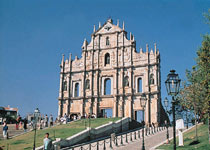
The Ruins of St. Paul's (also known as Sam Ba Sing Tzik) stands adjacent to the famous Mount Fortress and Macau Museum. The front fa?ade and the grand stone stairs are the only remains of the greatest church in Macau. First constructed in 1580, St. Paul's Church caught fires in 1595 and 1601. However, reconstruction started in 1602 soon after the church was burnt down. Completed in 1637, the church became the biggest Catholic Church in East Asia at that time. Unfortunately, a violent ... View Detail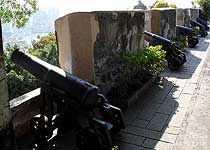
Fortress
Of all the forts in Macau, the Monte Fort is the oldest, lying to the east of the Ruins of St. Paul's. Built in 1616, it originally belonged to St. Paul's Church and was used to defend the church from the pirates. It later became solely a military fort. The fort is quadrilateral with bastions at each corner and about 100 meters (328 feet) in circumference. Barracks, cisterns and storehouses were the main buildings of the fort. An ancient tower situated here was one of the sites of the ... View Detail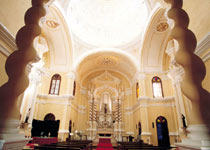
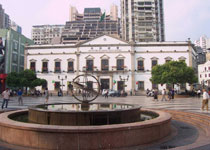
Leal Senado
This article is about the building. For the organization known as the Leal Senado, see Municipal Council of Macau.The Leal Senado Building (Portuguese for Loyal Senate) was the seat of Macau's government (Legislative Assembly of Macau and Municipal Council of Macau) during its time as a Portuguese colony. It is located at one end of the Senado Square. The title was bestowed on Macau's government in 1810 by Portugal's Prince-Regent Jo?o, who later became King John VI of Portugal. This ... View Detail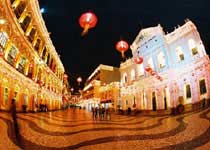
Holy House of Mercy House
The whitewashed, neoclassical building on the east hand side of the square is The Holy House of Mercy, a charitable, church organisation since its inception in the 16th century. Despite its divine mission, the building itself hasn't always been a home of praying and piety and the house has served as a refuge for prostitutes and was actually where Macau's first lottery ticket was sold - for charity of course. Today it's home to a small museum commemorating the Society's charitable ... View Detail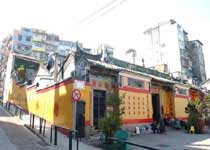
Package temple
Located in Fuqing Street, also known as Sleep Buddhist Temple. It was built during the Qing Dynasty fifteen years (1889). In that year, Macau prevailed pestilence, so the citizens invited Bao Gong to the gate of Sanba from Foshan. Later, the epidemic was greatly reduced, the residents believed that the gods had suppressed monsters. Then build a temple to worship the Lord Bao, so that could bless the people to drive the demon slayer and presided over the justice. In addition, there are other ... View Detail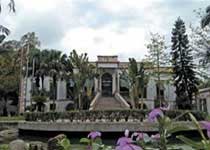
Casa
Casa Garden is a small parkette located in Macau Peninsula, Macau. Built in 1770, the park was originally the residence of a wealthy Portuguese merchant Manuel Pereira. At a later period, it was rented out to the English East India Company and was used to house the directors of the Macau branch of the company. The park contains the old residence, Old Protestant Cemetery and an art gallery.Later rented to the Macao Branch of the British East India Company as a residence for commercial directors ... View Detail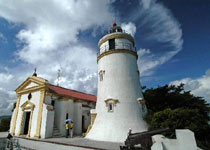
Guia Fort and Lighthouse
The Guia Fortress is a historical military fort, chapel, and lighthouse complex in the St. Lazarus Parish. The complex is a UNESCO World Heritage Site as part of the Historic Centre of Macau.Guia Fortress in Macau is well versed in the legends of the Macau isles. The structure like other forts in Macau was built in the 1630's to defend the border. The Virgin statue of Our lady of Guia Cathedral inside the fort, according to local fables left the chapel and repelled enemy bullets with her ... View Detail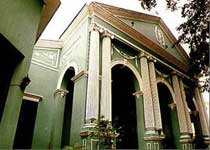
Dom Pedro V Theatre
Dom Pedro V Theatre, situated at Largo de Santo Agostinho, Macau, is one of the first western-style theatres in China. The theatre is an important landmark in the region and remains a venue for important public events and celebrations today. The Dom Pedro V Theatre was built in 1860 by local Portuguese to commemorate their reigning king, Peter V. The theatre is neo-classical in design, incorporating a portico front on a rectilinear plan.Dom Pedro V Theatre is neo-classical in design, ... View Detail