Guangzhou Weather


Guangzhou Attractions - Construction
View by Classification:
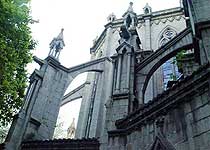
Shishi Sacred Heart Cathedral
The cathedral is a Gothic architecture. It covers the area of 2,754 square meters, with 35 meters wide, 78.69 meters long from north to south, and the twin towers rise as high as 58.5 meters. The west tower is a clock tower while the east tower serves as a bell tower, inside which there are five gigantic bronze bells shipped in from France in the 19th century. In the hall, the roof is arch doom. The adjacent of window on the front door and the walls surrounded are closed-palm shaped. All ... View Detail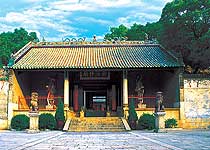
Nanhai Temple (Temple of the Baltic)
The old and magnificent Temple of Nanhai God is an important ruin in Guangzhou and serves to illustrate the city's long and colourful marine trade history with the rest of the world. It is the best-preserved example of its type and size in China. The Temple of Nanhai God has a history of more than 1,400 years, dating back to its construction in the fourteenth year of the reign of Emperor Suiwen. It was re-constructed and refurbished many times in successive dynasties, and in its present form ... View Detail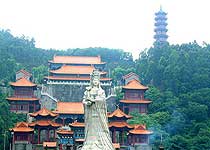
Nansha Tin Hau Temple
Nansha Tin Hau Temple Lingdingyang close to the Pearl River to the sea, is located in the south of Grand Cape Shandong, rivers, its construction and stacked on the mountain, glorious temple, magnificent pavilion in the center of the square is carving days after icon , to commemorate the sea goddess Lin Mo built, building characteristics, is a style of the Beijing Palace Museum and Nanjing in Nanjing, making one, the size of the modern world is most similar architecture, known as "the ... View Detail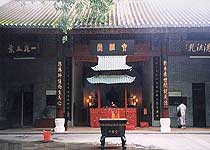
Six Banyan Temple
Having a long history of about 1,400 years, the Temple of the Six Banyan Trees is one of the four best Buddhist temples in Guangzhou and located on the Liurong Road (meaning the Six Banyan Trees Road). It has a rich collection of cultural-relics and is renowned both at home and abroad. Originally built in 537, the temple has been rebuilt several times, and the name has also been changed several times from Changshou Temple (meaning Longevity Temple) to Jinghui Temple and finally the current ... View Detail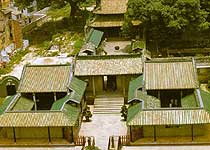
View of five cents
Wu Xian Guan(Temple of the Five Immortals)is dedicated to the "five immortals". It was built in the 10th year of Hongwu's reign of the Ming Dynasty (1377 A. D.). The huge recess in the shape of a footprint on the naked red sandstone was mistaken for the footprint of an immortal at ancient times. In fact, the strong current from the Pearl River crashed against the banks over times formed it. The site of the temple was close to the river before the Jin Dynasty.Legend It is said that ... View Detail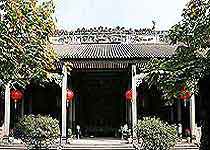
Ren Wei Temple
Ren Wei Temple, built in the forth year of the reign of Huangyou of the Song Dynasty, is a Taoist temple dedicated to worshiping the Northern Emperor. The buildings in the temple are solemn and simple, and have the special features of traditional Lingnan workmanship, and, as a result, are invaluable cultural relics in and of them. In 1983, Ren Wei Temple was recognized as a Municipal Cultural Relic Protection Unit. The main building of Ren Wei Temple is trapezoidal in shape. The wood carvings ... View Detail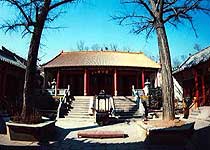
Sanyuan Temple
Sanyuan Temple This is the largest and oldest Taoist temple in the city. Located at the south foot of Yuexiu Hill (No. 11 Yinyuan Road) According to Taoist theory, the sky, earth and water are the three elements that make up the universe.,The Sanyuan Temple (literally "three elements") was built in the Eastern uin Dynasty, renamed the Wuxing Temple in the Tang Dynasty, but reverted to the Sanyuan Temple during the Ming Dynasty (1368-1644). The open-air Taoist temple offers visitors ... View Detail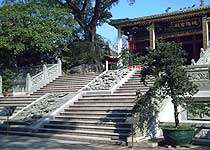
Pure Yang Concept
Situated on the Suzhu hillock of Wufeng Village, Chunyang Temple ( Chunyang Guan ) was founded in the sixth year (1826) of the Daoguang era of the Qing dynasty. Rather large in size, it once had over 20 mansions, such as the Mountain Gate, the Hall of the Numinous Officer, the Great Hall, the Tower for Ancestral Master Hua Tuo, the Platform for Worshiping the Dipper, etc., covering about ten thousand square meters. Now only the Mountain Gate, the Hall of The Numinous Officer ( Lingguan Dian ) ... View Detail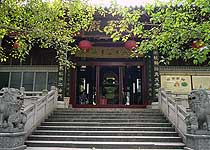
Sea Temple at
The Sea Monastery (chin.: haizhuangsi ), is today known as the Sea Park (chin.: Haizhuang Gongyuan ). Lying south of the Pearl River (chin; zhujiang ) is located between Nanhua Middle Road (chin.: nanhuazhonglu ), and Good fortune Tong fu Road (chin.: tongfulu ), and covers an area of 19,700 square metres. Haizhuang Park would be a nondescript park, but for the remains of what was once Guangzhou's largest monastery dating back to 1662. It was also one of the "Four Great Forests" (chin ... View Detail