Fuzhou Weather


Fuzhou Attractions - Construction
View by Classification:
Zen West
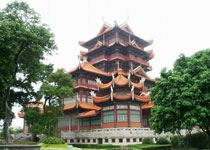
There has been a temple on this site to the west of Fuzhou since the Tang Dynasty but most of the buildings in the current temple were rebuilt during the Qing Dynasty. The 15-story Bao'en Tower is the tallest existing stone tower in China, reaching 61 meters in height. The Xichan temple complex is arranged symmetrically and consists of 36 halls, temples and pagodas. These include the Great Hall, the Hall of Deities, and the Hall of Arhats, which is one of the older structures in the area ... View Detail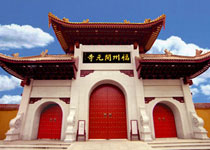
Kaiyuan Temple (Tiefo Si)
Located in the yard of Drum Tower District, Kaiyuan Temple was built in the third year of Emperor Tai Qing of the Nan Dynasty. It was initially named Dayun temple. At the beginning of Tang, it was called Longxing temple. In the year 738, xuangzong Li longji order to built a temple in each state, take the year as the name. So it is renamed Kaiyuan temple. It is the largest Buddhist Temple in Fuzhou; now about o-ne-tenth of its former size. It is the oldest Buddhist Temple in Fuzhou which has a ... View Detail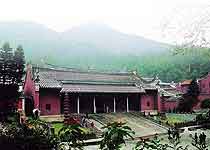
Yongquan Temple
Yongquan Temple is located on the mountaintop of Gu Mountain in Fuzhou City, Fujian Province. It was built in 908 A.D. and has an area of more than 4 acres. It has 25 halls, big or small. The temple maintains its original Ming-Qing architectural style. The main hall is magnificent and majestic. In the middle of the hall, there stand three Buddha. Beside the Buddha stand the Eighteen Arhats. They are different in facial expression and gesture. In the back of the hall, there is a three-sage statue ... View Detail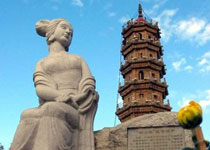
Luo Star Tower
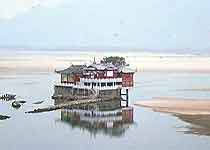
Luoxing Tower stands tall and upright o-n the top of the luoxing mountain which is 21 km away from fuzhou urban.In 1985, it was listed as the provincial level cultural relic preservation organ. Luoxing mountain is originally an island in the middle of the river, it is also called Moxin island. The seven-layer tower is octagonal and made of stone. It stands 31.5 m high at the Majiang River port. It has a legend that it is built by Liuqiliang who comes from Guangdong and beautiful. In order to ... View Detail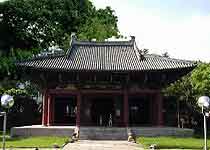
Hosts Hualin Temple
Hualin Temple has more than 1000 years of history ( it was firstly built in 964 A.D.). It is considered as a unique architecture. According to some Chinese and Japanese experts, the temple exerted great influence to the Japanese architecture at the end of the 12th century. So, the temple is also seen as an important symbol of Sino-Japanese cultural communication. The main hall is especially unique. It is 15.5 meters high, covering 574 square meters. The whole hall is supported by 18 columns ... View Detail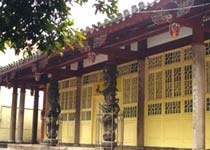
Fixed light pagoda (White Pagoda)
Dingguang Pagoda is located at the foot of the western part of Mount Yu. As it was painted white, it is known as the White Pagoda. According to an inscription on a stone tablet there, when ground was broken to lay the foundation for the pagoda, a glittering bead was unearthed. Hence the name Dingguang (Light Keeping) Pagoda. The pagoda was built in 904 in the Tang Dynasty. However, except for its stone base, no part of the original pagoda remains. The original pagoda was built of brick and had ... View Detail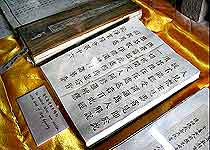
Canon Hall
The Cangjing Palace is located in Xichan Temple of Fuzhou and the distance is approximately 1.5 kilometers away from the center of Fuzhou. There are many sutras awarded by the previous emperors since the Song Dynasty in the palace.In addition of the temple's sutras, there are altogether 20,346 sutras in it. There are also 557 sutras found in the temple that were written with blood. They are rare cimelia of the country. As such, the Tibetan palace is known as the "ancient precious ... View Detail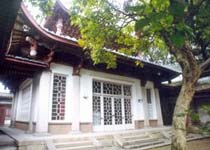
Tuas Temple (Goddess of Mercy House)
It is located in Yu Mountain, and is also Goddess of Mercy Pavilion. But its name had been changed as Wanshou Pavilion that consecrating a stele called "Wishing you a Long Life". In the second year of Qianlong Emperor, it was changed to consecrate the Avalokitesvara of South China Sea. Behide the hall, there was an inscription that narrating the story Avalokitesvara became an official and became a girl from a boy. When Fuzhou was recovered in the Revolution of 1911, the Revolutionary ... View Detail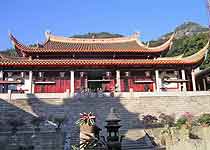
Main Hall
Mahavira Hall is the core of Yongquan Temple. There are three Sakyamuni statues called "Buddhas of Three Periods" in the middle of the hall, that means the past, now and the future. They are shaped in Ming Dynasty. The modelling of the statues are fine and smooth, showing grandfatherly eyebrow and kind eyes.Two copper little fairy children of more than 1m high are standing in the hall. Their head with double overhand knot and their cheek with dimple, and each of them is holding a flat ... View Detail