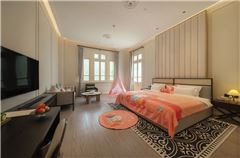
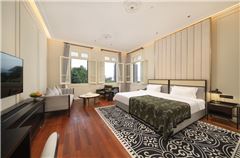
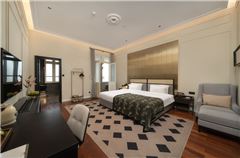
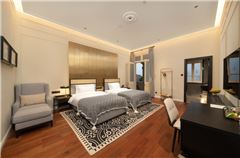
Huangjia Garden Hotel XiamenThe name of the hotel was originally the residence of the former British merchant Deji Trading Company's 'Er Zuo' (deputy manager), named 'Zhongde Ji'. It was first purchased by Lin Erjia and later sold to Huang Yizhu in 1917. Huang Yizhu settled on Gulangyu Island after returning from Indonesia in 1919. At that time, Huang Yizhu first built two symmetrical villas on both sides of the 'Er Zuo' residence, called the 'North and South Buildings', to accommodate his family. In 1921, Huang Yizhu demolished the residence of 'Er Zuo' and built the 'Zhong Lou'. It was not until 1925 that it was fully completed, with a total area of about 11988 square meters and a building area of about 4500 square meters. Due to some historical reasons, there are currently six buildings in Huangjia Garden. Before the establishment of the People's Republic of China, Republican politicians such as Wang Jingwei, Cai Tingkai, and Chiang Kai shek visited Huangjia Garden as guests; After the establishment of the People's Republic of China, Huangjia Garden and Guanhai Villa were converted by the Xiamen Municipal People's Government into the Gulangyu Cadre Rest and Rehabilitation Center in Fujian Province and the Xiamen Senior Cadre Guesthouse. In 1976, they were renamed as the Xiamen Third Guesthouse; In 1979, Huangjia Garden was renamed Gulangyu Hotel. From the 1950s to the 1980s, it hosted party and state leaders such as Wang Zhen; Foreign dignitaries such as Nixon and Lee Kuan Yew have also lived here; On July 8, 2017, Gulangyu Island successfully applied for World Heritage status. On the morning of January 28, 2018, the 'World Cultural Heritage' award ceremony was held at Huangjia Garden. Huangjia Garden was announced as a key protected historical building by the Xiamen Municipal People's Government in April 2001; In October 2018, it was announced by the People's Government of Fujian Province as the ninth batch of provincial-level cultural relics protection units; In October 2019, it was announced by the State Council of the People's Republic of China as the eighth batch of national key cultural relics protection units.